
Description
Premium HGH Fragment 176-191 (AOD-9604) for Sale | 5mg Lyophilized Powder | ≥99% Purity | 48-Hour Delivery Across EU & UK
HGH Fragment 176-191 (AOD-9604): The Advanced Lipolytic Peptide for Metabolic Research
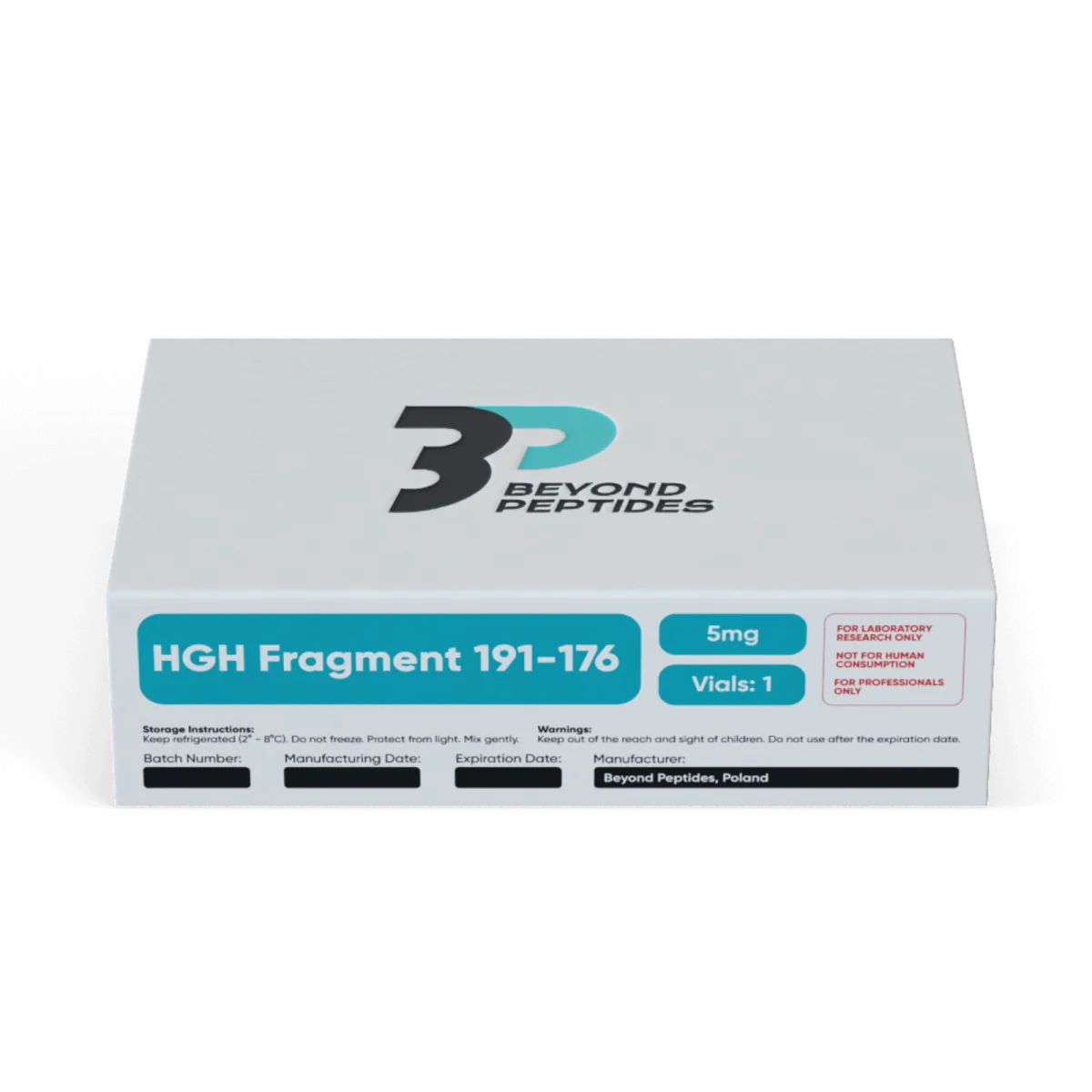
Buy HGH Fragment 176-191 Peptide EU & UK, eupeptidelap.co.uk is proud to present HGH Fragment 176-191 (also known as AOD-9604), a premium research-grade synthetic peptide fragment derived from the C-terminal region of human growth hormone (hGH), manufactured to the highest analytical standards. As a trusted peptide vendor uk and leading EU peptide supplier, we provide researchers across Europe with HGH Fragment 176-191 for sale that delivers exceptional purity, consistency, and documented quality for advanced studies in lipid metabolism, fat oxidation, and energy regulation.
HGH Fragment 176-191 (also referred to as AOD-9604) is a synthetic 15-amino acid peptide corresponding to the C-terminal region of human growth hormone, specifically the fragment encompassing amino acids 177-191 . This peptide was originally developed to isolate and harness the metabolic-regulating properties of growth hormone without the systemic hormonal activity associated with full-length hGH. Buy HGH Fragment 176-191 Peptide EU & UK
The amino acid sequence of HGH Fragment 176-191 is Tyr-Leu-Arg-Ile-Val-Gln-Cys-Arg-Ser-Val-Glu-Gly-Ser-Cys-Gly-Phe, with a molecular weight of approximately 1815.08 g/mol and molecular formula C₇₈H₁₂₃N₂₃O₂₃S₂ . Unlike full-length growth hormone, HGH Fragment 176-191 does not activate GH receptors and was specifically designed to stimulate fat oxidation without triggering the systemic endocrine effects of its parent molecule. Buy HGH Fragment 176-191 Peptide EU & UK
A landmark study published in Endocrinology (2001) demonstrated that both full-length hGH and HGH Fragment 176-191 reduce body weight and body fat in obese mice following chronic administration, correlating with increases in beta-3 adrenergic receptor (β3-AR) expression—the major lipolytic receptor found in fat cells . A 2008 study in the Journal of Endocrinology confirmed that the GH fragment 176-191 increases lipid oxidation in test systems and does not stimulate IGF-1 or GH signaling like full GH .
For researchers seeking to buy peptide online EU for investigations into metabolic disorders, obesity mechanisms, or lipid metabolism pathways, eupeptidelap.co.uk offers this premium research compound with comprehensive documentation, including Certificates of Analysis and batch-specific purity data. Whether your laboratory is based in London, Berlin, Paris, or anywhere in the European Union, our guaranteed 48 hour delivery peptide service ensures your research continues without interruption.
The Scientific Foundation of HGH Fragment 176-191 Research
Discovery and Development
HGH Fragment 176-191 was developed based on the observation that the lipolytic (fat-breaking) activity of human growth hormone resides in its C-terminal region, distinct from the domain responsible for its growth-promoting effects . This discovery enabled the creation of a synthetic peptide that could be studied for its metabolic properties in isolation, potentially offering a more targeted approach to obesity research.
Early studies in obese Zucker rats demonstrated that daily oral administration of HGH Fragment 176-191 at 500 μg/kg body weight for 19 days reduced body weight gain by over 50% (15.8 ± 0.6 vs. 35.6 ± 0.8 g) compared to controls . Importantly, unlike chronic treatment with intact hGH, this peptide showed no adverse effect on insulin sensitivity in these animal models, as demonstrated with euglycemic clamp techniques .
Mechanism of Action: β3-Adrenergic Receptor Pathway
The primary mechanism of HGH Fragment 176-191 involves modulation of the beta-3 adrenergic receptor (β3-AR) pathway. A pivotal study published in Endocrinology (2001) by Heffernan and colleagues demonstrated that both hGH and this GH fragment can reduce body weight and body fat in obese mice following 14 days of chronic intraperitoneal administration .
Key mechanistic findings include:
-
Increased β3-AR Expression: Both hGH and HGH Fragment 176-191 increase expression levels of β3-AR RNA—the major lipolytic receptor in fat cells—in obese mice, restoring them to levels comparable with those in lean mice
-
β3-AR Dependence: The importance of β3-AR was verified when long-term treatment with hGH and this GH fragment in β3-AR knock-out mice failed to produce the changes in body weight and increases in lipolysis observed in wild-type controls
-
Alternative Energy Pathways: In acute experiments, HGH Fragment 176-191 was capable of increasing energy expenditure and fat oxidation even in β3-AR knock-out mice, suggesting additional mechanisms may be involved
These findings indicate that while the lipolytic actions of HGH Fragment 176-191 are not mediated directly through β3-AR, the compound increases β3-AR expression, which may subsequently contribute to enhanced lipolytic sensitivity .
Effects on Lipid Metabolism
Research has demonstrated that HGH Fragment 176-191 influences lipid metabolism through multiple pathways:
Lipolysis Stimulation: The peptide increases lipolysis—the breakdown of triglycerides into free fatty acids and glycerol—in adipose tissue . In the 2000 study by Ng et al., adipose tissues from treated animals were found to have increased lipolytic activity compared to controls .
Lipogenesis Reduction: The peptide also reduces lipogenesis, the process of converting non-fat food materials into body fat . This dual action—increasing fat breakdown while decreasing fat formation—contributes to its overall effects on body composition.
Fat Oxidation Enhancement: Studies confirm that HGH Fragment 176-191 enhances fat oxidation, promoting the use of fatty acids as an energy source .
Safety and Tolerability Profile
The safety profile of HGH Fragment 176-191 has been evaluated in preclinical and early human studies. A randomized trial published in Regulatory Toxicology and Pharmacology found that the peptide showed good short-term tolerability and did not significantly change glucose or IGF-1 levels . Unlike full-length growth hormone, HGH Fragment 176-191 does not activate GH receptors and was designed to minimize negative endocrine effects .
Preclinical studies have revealed no evidence of genotoxicological or toxicological concerns, as examined in Ames tests, chromosomal aberration assays, and bone micronucleus assays . However, researchers should note that the FDA has not evaluated this peptide for safety, effectiveness, or manufacturing standards, and it is not approved for human therapeutic use .
Key Research Applications
Obesity and Weight Management Research
HGH Fragment 176-191 is extensively used in studies investigating body weight regulation and adipose tissue biology. Preclinical research has demonstrated:
-
Significant Weight Reduction: In obese Zucker rats, the peptide reduced body weight gain by over 50% compared to controls
-
Adipose Tissue Effects: Treated animals showed increased lipolytic activity in adipose tissues
-
β3-AR Upregulation: The peptide increases expression of the major lipolytic receptor in fat cells
Fat Metabolism Studies
Researchers utilize HGH Fragment 176-191 to investigate mechanisms of lipid metabolism:
-
Lipolysis Pathways: Study the breakdown of triglycerides in adipose tissue
-
Lipogenesis Regulation: Investigate the formation of new fat cells
-
Fat Oxidation: Explore the utilization of fatty acids for energy production
Metabolic Research
The peptide serves as a valuable tool for studying metabolic regulation without the confounding effects of full growth hormone:
-
Insulin Sensitivity Studies: Unlike intact hGH, this fragment shows no adverse effects on insulin sensitivity in research models
-
Energy Expenditure Research: Increases energy expenditure and fat oxidation
-
β-Adrenergic Pathway Studies: Investigate the role of beta-3 adrenergic receptors in metabolic regulation
Cartilage and Tissue Repair Research
Some exploratory studies have investigated HGH Fragment 176-191’s potential role in:
-
Cartilage Regeneration: Preliminary research has evaluated the peptide’s effects on joint repair models
-
Post-Injury Recovery: Explored for potential applications in tissue healing
-
Inflammation Modulation: Studied for effects on inflammatory pathways
However, researchers should note that these applications are preliminary and based on early-phase studies .
Quality Assurance: Setting the Standard for Research Compounds
Manufacturing Excellence
eupeptidelap.co.uk sources HGH Fragment 176-191 from certified GMP facilities with rigorous quality control protocols:
-
HPLC Purity Analysis: ≥99% purity verified by high-performance liquid chromatography
-
Mass Spectrometry Verification: Molecular weight confirmation (1815.08 g/mol) via LC-HRMS
-
Batch-Specific Certificates of Analysis: Complete documentation for each production run
-
Research-Use Only (RUO) Labeling: Full compliance with research compound regulations
Chemical and Product Specifications
| Specification | Detail |
|---|---|
| Product Name | HGH Fragment 176-191 (Growth Hormone Fragment 177-191, AOD-9604) |
| CAS Number | 221231-10-3 |
| Molecular Formula | C₇₈H₁₂₃N₂₃O₂₃S₂ |
| Molecular Weight | 1815.08 g/mol |
| Amino Acid Sequence | Tyr-Leu-Arg-Ile-Val-Gln-Cys-Arg-Ser-Val-Glu-Gly-Ser-Cys-Gly-Phe |
| Purity | ≥99% (HPLC verified) |
| Appearance | White to off-white lyophilized powder |
| Form | Lyophilized powder |
| Solubility | Soluble in sterile water, bacteriostatic water, or aqueous buffers |
| Storage (Lyophilized) | -20°C; protect from light and moisture |
| Storage (Reconstituted) | 2-8°C for short-term; aliquot and store at -20°C for longer storage |
| Shelf Life | 24 months from date of manufacture (lyophilized) |
| Intended Use | Research and laboratory use only |
| Documentation | Certificate of Analysis provided with each batch |
Stability and Handling Guidelines
Lyophilized Powder Storage: Store lyophilized HGH Fragment 176-191 powder at -20°C in a dry, dark environment, protected from light and moisture . Under proper storage conditions, the powder maintains stability for up to 24 months from the date of manufacture. Wherever possible, prepare and use solutions on the same day .
Reconstitution Protocol:
-
Allow vial and solvent to reach ambient temperature before opening to prevent condensation
-
Reconstitute using sterile bacteriostatic water or suitable solvent according to research protocol
-
Inject solvent slowly down the inside wall of the vial to minimize foaming
-
Gently swirl or roll the vial until fully dissolved—do not shake vigorously
-
Label the vial with the date of reconstitution
-
Refrigerate immediately at 2-8°C
Reconstituted Solution Storage: For short-term use, store at 2-8°C. If preparing stock solutions in advance, store the solution as aliquots in tightly sealed vials at -20°C . These are generally usable for up to one month. Avoid repeated freeze-thaw cycles.
Protection from Light and Moisture:
-
Store in original packaging protected from light
-
Keep vials tightly sealed when not in use
-
Allow refrigerated vials to reach room temperature before opening to prevent condensation
Key Benefits
-
Premium Quality Manufacturing: GMP-certified production, ≥99% HPLC-verified purity with lot-specific COAs
-
Well-Characterized Mechanism: Over two decades of published research on β3-AR pathway interactions
-
Lipolysis Stimulation: Increases breakdown of triglycerides in adipose tissue
-
Lipogenesis Reduction: Decreases formation of new fat cells
-
Fat Oxidation Enhancement: Promotes utilization of fatty acids for energy
-
β3-AR Upregulation: Increases expression of the major lipolytic receptor in fat cells
-
Obesity Research Applications: Demonstrated weight reduction in animal models
-
Metabolic Studies: Investigate lipid metabolism without GH-related endocrine effects
-
Insulin Sensitivity Research: No adverse effects on insulin sensitivity in animal models
-
Energy Expenditure Studies: Increases energy expenditure and fat oxidation
-
Cartilage Repair Research: Preliminary investigations in tissue regeneration models
-
Safety Profile: Good short-term tolerability; no genotoxicological concerns in preclinical studies
-
Stable Formulation: 24-month shelf life under proper storage conditions
-
Comprehensive Documentation: Certificates of Analysis with batch-specific purity data
-
48-Hour EU & UK Delivery: Rapid shipping to research facilities across Europe
-
Batch Consistency: Rigorous quality control ensures lot-to-lot reproducibility
-
EU Sourced: Available from within the European Union
Frequently Asked Questions
Q: What is HGH Fragment 176-191 and how does it work?
A: HGH Fragment 176-191 (AOD-9604) is a synthetic 15-amino acid peptide derived from the C-terminal region of human growth hormone . It works by increasing β3-AR expression in fat cells, stimulating lipolysis (fat breakdown), reducing lipogenesis (fat formation), and enhancing fat oxidation . Unlike full-length growth hormone, it does not activate GH receptors or stimulate IGF-1 signaling .
Q: What purity level can I expect when I buy HGH Fragment 176-191 from eupeptidelap.co.uk?
A: All HGH Fragment 176-191 from eupeptidelap.co.uk is tested to ≥99% purity by HPLC . Each batch is individually analyzed, and Certificates of Analysis are provided with every order, ensuring you receive material suitable for rigorous research applications.
Q: What is the molecular weight and sequence of HGH Fragment 176-191?
A: HGH Fragment 176-191 has a molecular weight of 1815.08 g/mol, molecular formula C₇₈H₁₂₃N₂₃O₂₃S₂, and the amino acid sequence Tyr-Leu-Arg-Ile-Val-Gln-Cys-Arg-Ser-Val-Glu-Gly-Ser-Cys-Gly-Phe .
Q: What research areas commonly use HGH Fragment 176-191?
A: The peptide is widely used in obesity and weight management research, lipid metabolism studies, fat oxidation research, β3-AR pathway investigations, metabolic studies, and preliminary cartilage repair research .
Q: How should I store HGH Fragment 176-191 for long-term stability?
A: Store lyophilized powder at -20°C, protected from light and moisture . Under proper storage conditions, the powder maintains stability for up to 24 months. For short-term use, store reconstituted solution at 2-8°C; for longer-term storage, aliquot and store at -20°C .
Q: What is the mechanism of action of HGH Fragment 176-191?
A: The peptide increases expression of β3-AR, the major lipolytic receptor in fat cells, restoring levels in obese models to those comparable with lean controls . This upregulation enhances lipolytic sensitivity. The peptide also stimulates lipolysis, reduces lipogenesis, and increases fat oxidation .
Q: Is HGH Fragment 176-191 legal to purchase for research in the UK and EU?
A: The peptide is not approved for human use by the MHRA in the UK or the EMA in the EU . It is sold strictly for research purposes only. The sale of unlicensed peptides under “research use only” labeling is permissible for legitimate research purposes when supplied to qualified buyers such as laboratories and research facilities .
Q: Do you ship HGH Fragment 176-191 to EU countries?
A: Yes. As a dedicated EU peptide supplier, we ship to all European Union member states with our guaranteed 48 hour delivery peptide service. Our EU fulfilment centre ensures rapid delivery without customs delays. All shipments use protective packaging to maintain compound integrity during transit.
Q: What documentation do you provide with orders?
A: Every order includes a Certificate of Analysis (COA) with batch-specific purity data . Additional documentation, including HPLC chromatograms and mass spectrometry data, is available upon request for researchers requiring comprehensive analytical verification. . . . . . . . . . . . . . . . . . . . . . . . . . . . . . . . . . . . . . . .
Q: Do you offer bulk quantities for institutional research?
A: Yes. We accommodate bulk orders for research institutions. Contact our team at sales@eupeptidelap.co.uk for volume pricing, custom requirements, and supply agreements for ongoing research programs.
Advance Your Research with HGH Fragment 176-191
eupeptidelap.co.uk is your trusted source for HGH Fragment 176-191, the premium choice for researchers investigating lipid metabolism, obesity mechanisms, and β3-AR pathway signaling. With over two decades of published research supporting its effects on lipolysis, fat oxidation, and energy regulation, this peptide represents a well-characterized tool for exploring the complex biology of adipose tissue metabolism. ...........................................
Whether you are exploring lipolysis mechanisms, designing obesity studies, investigating fat oxidation pathways, or researching β-adrenergic receptor signaling, our rigorously tested compound provides the quality and consistency your work demands.
Order today and experience the eupeptidelap.co.uk difference – premium quality, rapid 48-hour delivery across the EU and UK, and expert support for the European research community.