

Description
Premium BPC-157 Peptide for Sale | 5mg Lyophilized Powder | ≥97% Purity | 48-Hour Delivery Across EU & UK
BPC-157: The Revolutionary Body Protection Compound for Regenerative Research
eupeptidelap.co.uk is proud to present BPC-157 5mg, a premium research-grade pentadecapeptide manufactured to the highest analytical standards. As a trusted peptide vendor uk and leading EU peptide supplier, we provide researchers across Europe with BPC-157 for sale that delivers exceptional purity, consistency, and documented quality for advanced studies in tissue regeneration, wound healing, and angiogenesis .
BPC-157 (Body Protection Compound-157) is a 15-amino acid synthetic peptide (Gly-Glu-Pro-Pro-Pro-Gly-Lys-Pro-Ala-Asp-Asp-Ala-Gly-Leu-Val) with a molecular weight of approximately 1419 Da . It is derived from a protective protein found in human gastric juice and was first described in the scientific literature in 1993 by Sikirić and colleagues . The peptide demonstrates remarkable chemical stability, maintaining its biological activity even under harsh conditions such as enzymatic degradation, gastric fluid, and room temperature storage for up to three weeks .
BPC-157 exerts its effects through multiple interconnected mechanisms that have been elucidated through decades of preclinical research. A landmark study published in Cell Communication and Signaling (2026) revealed that intracellular BPC-157 engages the E3 ubiquitin ligase adaptor protein FBXO22 through its proline residue at position 3 . This interaction results in the formation of a protein complex that suppresses the ubiquitination and subsequent proteasomal degradation of the transcription factor BACH1, leading to significant stabilization of BACH1 protein levels. The consequent accumulation of BACH1 enhances critical processes in vascular regeneration, namely, the proliferation and tube-forming capacity of vascular endothelial cells .
For researchers seeking to buy peptide online EU for investigations into tissue repair, inflammatory bowel disease, musculoskeletal recovery, or neuroregeneration, eupeptidelap.co.uk offers this premium research compound with comprehensive documentation, including Certificates of Analysis and batch-specific purity data. Whether your laboratory is based in London, Berlin, Paris, or anywhere in the European Union, our guaranteed 48 hour delivery peptide service ensures your research continues without interruption.
The Scientific Foundation of BPC-157 Research
Discovery and Historical Context
BPC-157 was originally identified as a naturally occurring peptide endogenous to human gastric juice that promotes mucosal integrity and homeostasis . The peptide exerts a significant protective effect on various tissues and organs, including the esophagus, stomach, duodenum, colorectal mucosa, liver, pancreas, muscle, cornea, heart and nerves . Over three decades of research, the peptide’s applications have expanded far beyond gastrointestinal healing to encompass musculoskeletal repair, wound healing, angiogenesis, and neuroprotection.
Mechanism of Action: The FBXO22-BACH1 Axis
A landmark study published in 2026 has elucidated a primary molecular mechanism underlying BPC-157’s proangiogenic effects . Using biotin-labeled BPC-157 and co-immunoprecipitation assays followed by mass spectrometry, researchers identified FBXO22 as the strongest interactor with BPC-157. Immunofluorescence and ELISA further confirmed the intracellular colocalization of BPC-157 with FBXO22 .
Molecular docking simulations predicted a stable binding conformation with electrostatic interactions dominating the binding interface. Hydrogen bonding was observed between residues G1, E2, P3, K7, and V15 of BPC-157 and E31, R58, and E183 of FBXO22 . Alanine-scanning mutagenesis confirmed that the proline residue at position 3 serves as the key binding site for FBXO22.
This interaction suppresses the ubiquitination and proteasomal degradation of the transcription factor BACH1, leading to its stabilization. BACH1 accumulation then enhances the proliferation and tube-forming capacity of vascular endothelial cells, driving angiogenesis and tissue repair .
Additional Molecular Pathways
Beyond the FBXO22-BACH1 axis, BPC-157 activates multiple pathways involved in tissue regeneration :
-
VEGF-Dependent Pathway: BPC-157 activates VEGFR2–PI3K–Akt–eNOS signaling, promoting NO production, angiogenesis, vasodilation, and vascular stability
-
VEGF-Independent Pathway: The peptide also activates Src–caveolin-1–eNOS signaling, further supporting endothelial function
-
ERK1/2 Activation: In endothelial cells, BPC-157 activates ERK1/2 signaling, enhancing proliferation, migration, and vascular tube formation through transcription factors like c-Fos, c-Jun, and Egr-1
-
FAK-Paxillin Pathway: BPC-157 promotes tendon fibroblast outgrowth, cell survival under stress, and migration through activation of the FAK-paxillin pathway
-
Cytoprotective Factor Upregulation: BPC-157 upregulates heme oxygenase-1 (HO-1) and heat shock proteins, preserving mitochondrial integrity and reducing oxidative stress
Key Research Applications
Gastrointestinal Research: BPC-157 was first identified in gastric juice and has been extensively studied for its gastroprotective properties. It promotes healing of GI ulcers, anastomotic sites, various GI fistulas, and shows efficacy in models of inflammatory bowel disease .
Musculoskeletal Recovery Research: BPC-157 has demonstrated remarkable effects on tendon, ligament, and muscle healing. Studies in rats with Achilles tendon injuries showed accelerated healing with improved collagen fiber formation rates and interfiber spacing recovery (0.62 ± 0.21 μm vs 0.18 ± 0.15 μm, p < 0.005) . The peptide promotes the repair of damaged cartilage, tendons, and ligaments through FAK-paxillin pathway activation .
Angiogenesis Research: Comparative angiogenic profiling through CD31 immunohistochemistry revealed a dose-dependent increase in microvascular density in BPC-157-treated rodent skeletal muscle contusion models (muscle injury model: 1.7 ± 0.4 vessels vs. 6.2 ± 3.2 in the BPC-157-treated group, p < 0.001) . This neovascularization was consistently observed in murine full-thickness burn injuries and rat dermal incisional wounds .
Cell Proliferation and Tube Formation: In human umbilical vein endothelial cells (HUVECs), BPC-157 treatment at concentrations of 5 µg/mL, 10 µg/mL, or 20 µg/mL significantly enhanced cell viability in a concentration-dependent manner . The peptide also promoted more extensive tube formation in a dose-dependent manner when HUVECs were plated on Matrigel . Mechanistically, BPC-157 significantly upregulated the expression of PDGF subunit B (PDGFB), FGF2, FGF receptor (FGFR), and EGF receptor (EGFR) .
Wound Healing Research: During the development of “HuBPP Body Protective Polypeptide Injection,” systematic pharmacodynamic evaluations using standardized experimental models—murine full-thickness burn injuries, rat dermal incisional wounds, and rodent skeletal muscle contusion models—demonstrated significant therapeutic efficacy of BPC-157 in accelerating tissue regeneration .
Inflammatory Condition Research: BPC-157’s anti-inflammatory properties make it valuable for researching inflammatory conditions. It modulates inflammatory cytokines and promotes anti-inflammatory substances, supporting the healing process .
Safety Profile in Preclinical Studies: Preclinical safety studies have shown no adverse effects across several organ systems, with LD1 not achieved . Pharmacokinetic profiling revealed linear dose‒exposure relationships, with [³H]BPC-157 rapidly metabolized into small peptides and ultimately tritium-labeled proline for normal amino acid catabolism/excretion .
Quality Assurance: Setting the Standard for Research Compounds
Manufacturing Excellence
eupeptidelap.co.uk sources BPC-157 5mg from certified GMP facilities with rigorous quality control protocols:
-
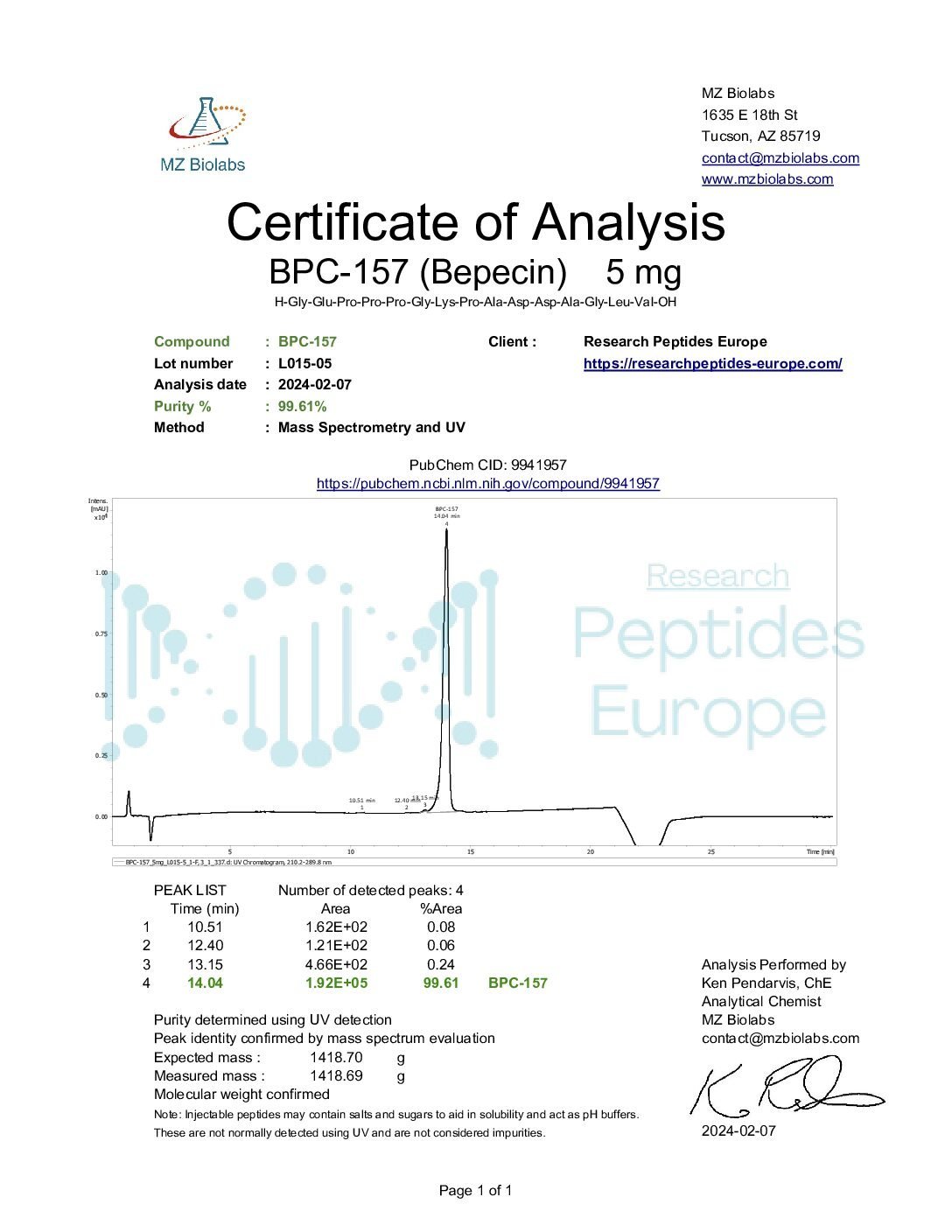
HPLC Purity Analysis: ≥97% purity verified by reverse-phase high-performance liquid chromatography
-
Mass Spectrometry Verification: Molecular weight confirmation (~1419 Da) via LC-HRMS
-
Batch-Specific Certificates of Analysis: Complete documentation for each production run
-
Sterile Manufacturing: Lyophilized with no additives; sterile filtered
-
Research-Use Only (RUO) Labeling: Full compliance with research compound regulations
Chemical and Product Specifications
| Specification | Detail |
|---|---|
| Product Name | BPC-157 (Body Protection Compound-157) |
| Amino Acid Sequence | H-Gly-Glu-Pro-Pro-Pro-Gly-Lys-Pro-Ala-Asp-Asp-Ala-Gly-Leu-Val-OH |
| Molecular Formula | C₆₂H₉₈N₁₆O₂₂ |
| Molecular Weight | 1419 Da |
| CAS Number | 137525-51-0 |
| Purity | ≥97.0% (HPLC verified) |
| Appearance | Sterile filtered white lyophilized powder |
| Form | Lyophilized powder with no additives |
| Solubility | Reconstitute in sterile 18MΩ-cm H₂O at not less than 100 μg/ml, further dilutable to other aqueous solutions |
| Storage (Lyophilized) | Below -18°C, desiccated; stable at room temperature for 3 weeks |
| Storage (Reconstituted) | 4°C for 2-7 days; below -18°C for long-term with carrier protein (0.1% HSA or BSA) |
| Half-Life | Rapidly metabolized into small peptides |
| Metabolism | Amino acid catabolism; no significant liver toxicity |
| Shipping | Ambient temperature with protective packaging; ice packs during transit |
| Intended Use | Research and laboratory use only |
| Documentation | Certificate of Analysis provided with each batch |
Stability and Handling Guidelines
Lyophilized Powder Storage: Store lyophilized BPC-157 powder below -18°C in a dry, dark environment, protected from light and moisture, and kept desiccated . While the peptide is stable at room temperature for up to 3 weeks, refrigeration or freezing is recommended for extended storage .
Reconstitution Protocol:
-
Allow vial and solvent to reach ambient temperature before opening to prevent condensation
-
Reconstitute using sterile 18MΩ-cm H₂O at not less than 100 μg/ml, which can then be further diluted to other aqueous solutions
-
Inject solvent slowly down the inside wall of the vial to minimize foaming
-
Gently swirl or roll the vial until fully dissolved—do not shake vigorously
-
Label the vial with the date of reconstitution
-
Refrigerate immediately at 4°C
Reconstituted Solution Storage: Store reconstituted BPC-157 at 4°C for 2-7 days . For long-term storage, aliquot into single-use portions, add a carrier protein (0.1% HSA or BSA), and store below -18°C . Prevent repeated freeze-thaw cycles.
Protection from Light and Moisture:
-
Store in original packaging protected from light
-
Keep vials tightly sealed when not in use
-
Allow refrigerated vials to reach room temperature before opening to prevent condensation
Key Benefits
-
Premium Quality Manufacturing: GMP-certified production, ≥97% HPLC-verified purity
-
Well-Characterized Mechanism: Novel FBXO22-BACH1 axis elucidated in 2026 research
-
Angiogenesis Stimulation: Increases microvascular density in injury models (1.7 vs 6.2 vessels, p < 0.001)
-
Endothelial Cell Proliferation: Enhances HUVEC viability in concentration-dependent manner
-
Tube Formation Enhancement: Promotes capillary-like structure formation on Matrigel
-
Growth Factor Upregulation: Increases PDGFB, FGF2, FGFR, and EGFR expression
-
FAK-Paxillin Pathway Activation: Promotes tendon fibroblast migration and survival
-
Gastrointestinal Research: Extensive evidence in IBD, ulcer, and GI injury models
-
Musculoskeletal Recovery: Accelerates tendon, ligament, and muscle healing
-
Wound Healing: Promotes re-epithelialization and tissue regeneration in burn and incisional models
-
VEGF Pathway Activation: Acts through VEGFR2–PI3K–Akt–eNOS signaling
-
ERK1/2 Signaling: Enhances proliferation and migration through ERK1/2 activation
-
Cytoprotective Properties: Upregulates HO-1 and heat shock proteins
-
Favorable Safety Profile: No adverse effects in preclinical studies; LD1 not achieved
-
Well-Characterized Pharmacokinetics: Linear dose-exposure relationships, rapid metabolism
-
Comprehensive Documentation: Certificates of Analysis with batch-specific purity data
-
48-Hour EU & UK Delivery: Rapid shipping to research facilities across Europe
-
Batch Consistency: Rigorous quality control ensures lot-to-lot reproducibility
-
EU Sourced: Available from within the European Union
Frequently Asked Questions
Q: What is BPC-157 and where does it come from?
A: BPC-157 (Body Protection Compound-157) is a 15-amino acid synthetic peptide (Gly-Glu-Pro-Pro-Pro-Gly-Lys-Pro-Ala-Asp-Asp-Ala-Gly-Leu-Val) derived from a protective protein found in human gastric juice . It was first described in the scientific literature in 1993 by Sikirić and colleagues .
Q: What is the mechanism of action of BPC-157?
A: BPC-157 binds to FBXO22 through its proline residue at position 3, suppressing the ubiquitination and degradation of the transcription factor BACH1 . BACH1 stabilization enhances endothelial cell proliferation and tube formation, driving angiogenesis and tissue repair. The peptide also activates VEGF-dependent and independent pathways, ERK1/2 signaling, and the FAK-paxillin pathway .
Q: What purity level can I expect when I buy BPC-157 from eupeptidelap.co.uk?
A: All BPC-157 5mg from eupeptidelap.co.uk is tested to ≥97% purity by HPLC . Each batch is individually analyzed, and Certificates of Analysis are provided with every order, ensuring you receive material suitable for rigorous research applications.
Q: How should I store BPC-157 for long-term stability?
A: Store lyophilized BPC-157 powder below -18°C, protected from light and moisture, and kept desiccated . While stable at room temperature for up to 3 weeks, refrigeration or freezing is recommended for extended storage .
Q: What is the recommended reconstitution protocol for BPC-157?
A: Reconstitute using sterile 18MΩ-cm H₂O at not less than 100 μg/ml, which can then be further diluted to other aqueous solutions . Inject solvent slowly, gently swirl—do not shake. After reconstitution, store at 4°C for 2-7 days. For long-term storage, add a carrier protein (0.1% HSA or BSA) and store below -18°C .
Q: What research areas commonly use BPC-157?
A: BPC-157 is widely used in gastrointestinal research (IBD, ulcers) , musculoskeletal recovery studies (tendon, ligament, muscle healing) , wound healing research , angiogenesis research , and neuroprotection studies .
Q: What is the half-life of BPC-157?
A: BPC-157 is rapidly metabolized into small peptides and ultimately tritium-labeled proline for normal amino acid catabolism/excretion . Pharmacokinetic studies in animals reveal linear dose‒exposure relationships .
Q: Is BPC-157 legal to purchase in the UK?
A: BPC-157 is sold strictly for research purposes only and is not approved for human consumption by the MHRA in the UK or the FDA in the US . At eupeptidelap.co.uk, all products are intended for research and laboratory use only.
Q: Do you ship BPC-157 to EU countries?
A: Yes. As a dedicated EU peptide supplier, we ship BPC-157 5mg to all European Union member states with our guaranteed 48 hour delivery peptide service. Our EU fulfilment centre ensures rapid delivery without customs delays. All shipments use protective packaging to maintain compound integrity during transit.
Q: What documentation do you provide with BPC-157 orders?
A: Every order includes a Certificate of Analysis (COA) with batch-specific purity data. Additional documentation, including HPLC chromatograms and mass spectrometry data, is available upon request for researchers requiring comprehensive analytical verification.
Q: Does BPC-157 have applications in nervous system research?
A: Yes. Research demonstrates BPC-157 has neuroprotective effects, promoting recovery after neural injury and modulating neurotransmitter systems . Studies show it can improve motor coordination and cognitive performance in animal models .
Q: What is the role of BPC-157 in angiogenesis research?
A: BPC-157 promotes angiogenesis through multiple mechanisms: FBXO22-BACH1-mediated endothelial proliferation , VEGF-dependent (VEGFR2–PI3K–Akt–eNOS) and independent (Src–caveolin-1–eNOS) pathways , and ERK1/2 activation . In animal models, BPC-157 increased microvascular density from 1.7 to 6.2 vessels (p < 0.001) .
Q: Do you offer bulk quantities of BPC-157 for institutional research?
A: Yes. We accommodate bulk orders for research institutions. Contact our team at sales@eupeptidelap.co.uk for volume pricing, custom requirements, and supply agreements for ongoing research programs.
Q: Is BPC-157 banned in sports?
A: Yes. BPC-157 is currently prohibited by the World Anti-Doping Agency and does not carry regulatory approval . Researchers working with athletic populations should be aware of these regulations.
Advance Your Research with BPC-157 5mg
eupeptidelap.co.uk is your trusted source for BPC-157 5mg, the premium choice for researchers investigating tissue regeneration, angiogenesis, gastrointestinal health, and musculoskeletal repair. With over three decades of preclinical research supporting its cytoprotective and regenerative properties and a newly elucidated molecular mechanism involving the FBXO22-BACH1 axis , BPC-157 represents one of the most extensively studied and versatile peptides in the research community. ...........................................
Whether you are exploring angiogenesis pathways, designing wound healing studies, investigating inflammatory bowel disease, or researching musculoskeletal recovery mechanisms, our rigorously tested compound provides the quality and consistency your work demands. . . . . . . . . . . . . . . . . . . . . . . . . . . . . . . . . . . . . . . . . .
Order today and experience the eupeptidelap.co.uk difference – premium quality, rapid 48-hour delivery across the EU and UK, and expert support for the European research community.


